

 Duyen Nguyen
Fixtures are indispensable technological equipment, often referred to as the “heart” of precision machining and advanced manufacturing. But what exactly are fixtures, why are they so critical, and how can you select the most suitable solution? This article provides a complete A–Z overview to help you master this essential tool and apply it effectively in production.
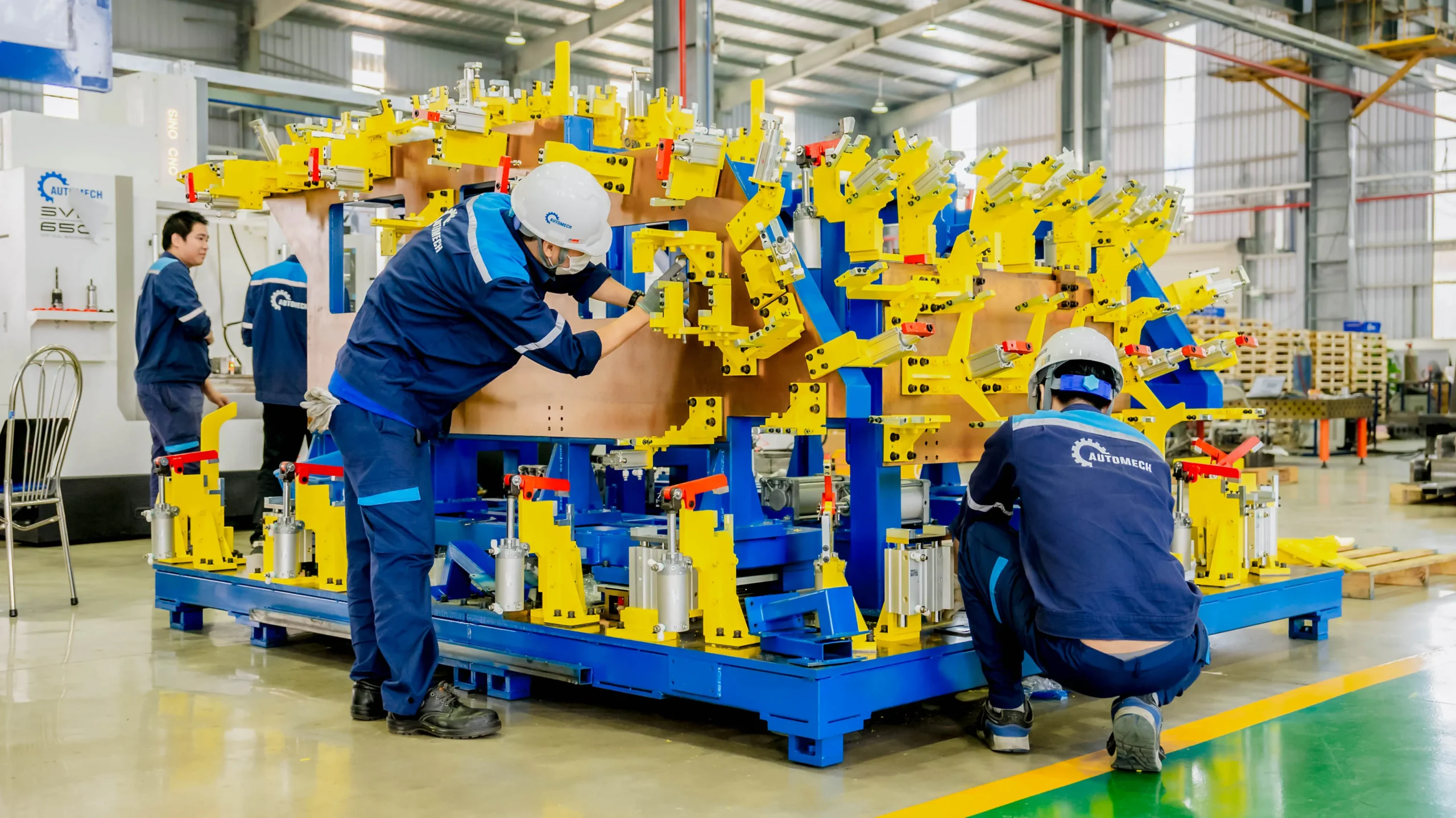
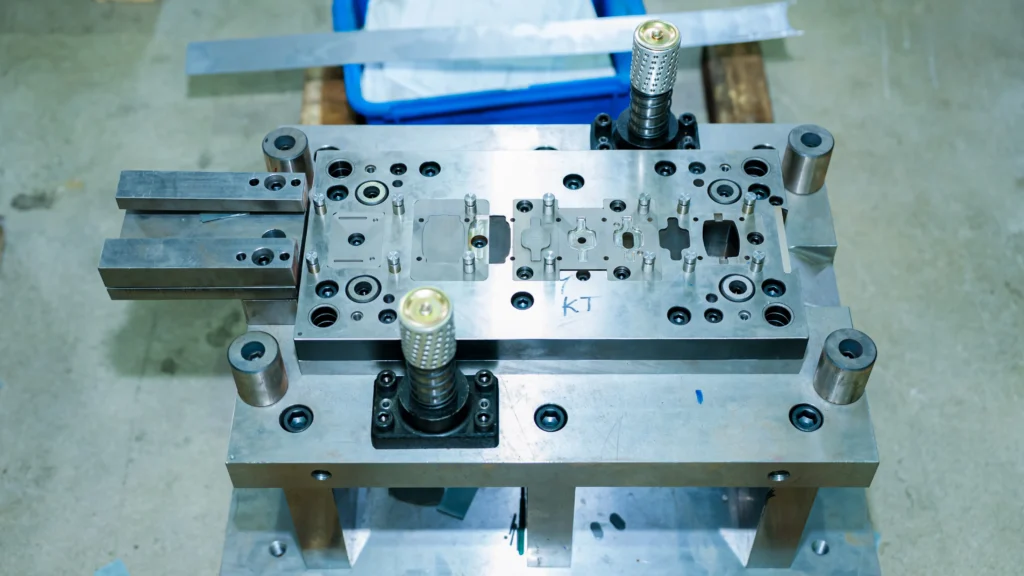
A complex fixture set used in the mechanical engineering industry
1. General Introduction to Fixtures
1.1. What Are Fixtures? Their Role in Machining
Fixtures (English: Jigs & Fixtures) are auxiliary devices designed to locate, clamp, and in some cases guide cutting tools, ensuring precise positioning of the workpiece relative to the machine and the tool.
Key functions include:
-
Accurate positioning: Ensures the workpiece is always located at one fixed position for every machining cycle.
-
Rigid clamping: Prevents displacement under cutting forces, ensuring safety and quality.
-
Productivity boost: Significantly reduces manual setup time, enabling high-volume manufacturing.
1.2. Fixtures vs. Other Workholding Tools
Many confuse fixtures with tools like vises or clamps. The key difference lies in repeatable precision positioning. While a vise only clamps, a fixture is custom-engineered for a specific part or machining operation, guaranteeing uniformity across all produced parts.
1.3. Why Fixtures Are Indispensable in Mass Production
In mass production, consistency and speed are paramount. Fixtures eliminate manual marking and measuring for each part, minimizing idle time, increasing throughput, and ensuring that thousands of parts meet identical quality standards.
2. Common Types of Fixtures
Depending on function and machining operation, fixtures are classified into:
A milling fixture that secures the workpiece for precise machining
2.1. Drilling Fixtures, Milling Fixtures, Welding Fixtures
-
Drilling Fixture: Positions and clamps workpieces during hole drilling. Often equipped with guide bushings for precise drill alignment.
-
Milling Fixture: Used on milling machines; designed to withstand complex and heavy cutting forces.
-
Welding Fixture: Holds components in exact relative positions before and during welding, preventing thermal distortion.
2.2. Turning Fixtures, Assembly Fixtures, Inspection Fixtures
-
Turning Fixture: Often in the form of chucks, used to mount complex-shaped parts on lathes.
-
Assembly Fixture: Assists in aligning and securing parts for fast and accurate assembly.
-
Inspection Fixture: Verifies geometric and dimensional accuracy of machined parts.
2.3. Benefits of Specialized Fixtures
Using purpose-designed fixtures for each operation optimizes the process, maximizes machine capability, and ensures the highest accuracy.
3. Practical Applications in Manufacturing
Fixtures are present in nearly every manufacturing sector.
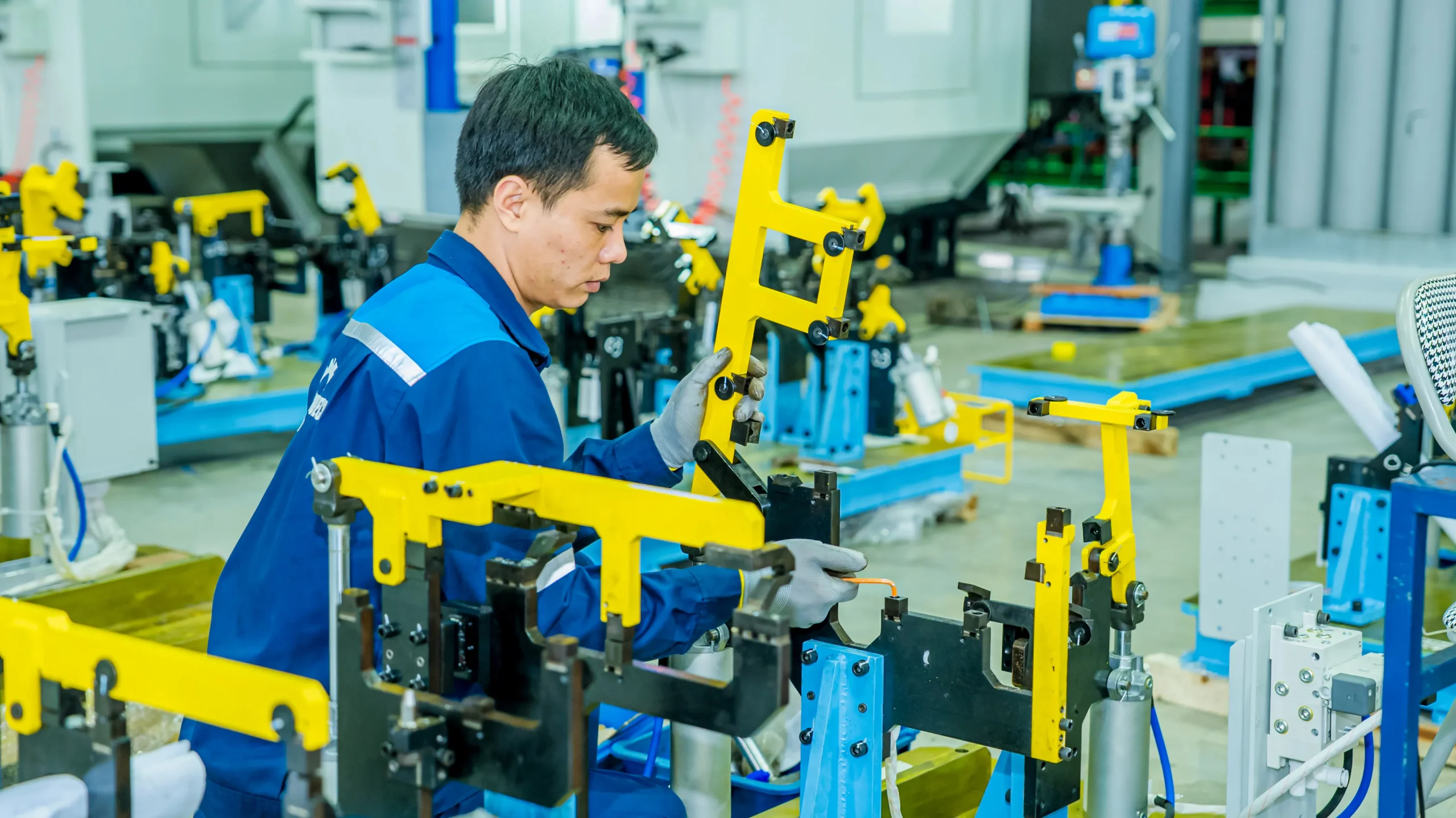
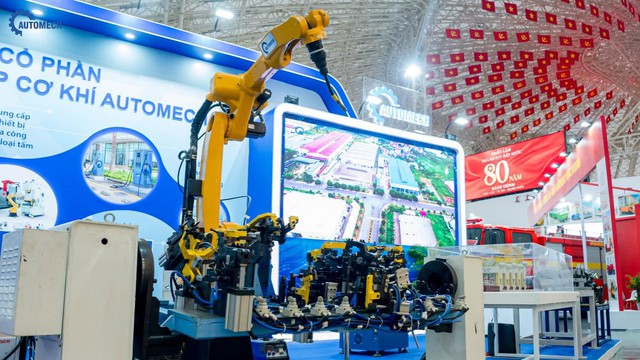
An automated welding fixture system in the automotive industry
3.1. Mechanical Engineering
-
Enhances precision while reducing setup time in machining components, molds, and tooling.
3.2. Automotive, Electronics, Furniture
-
Automotive: Welding jigs for car frames, assembly fixtures for interiors.
-
Electronics: PCB inspection fixtures, component assembly jigs.
-
Furniture: Hinge drilling fixtures, chair frame assembly jigs.
3.3. Example – Automotive Body Welding Line
In an automated car body welding line, robots place components into a complex welding fixture system. The system clamps them with absolute precision, enabling robots to weld consistently, ensuring frame uniformity and rigidity.
4. Structure and Operating Principle of Fixtures
4.1. Main Components
-
Fixture body/base: Foundation for mounting other modules, requiring high rigidity.
-
Locating elements: Pins, rests, V-blocks – establish reference points for the workpiece.
-
Clamping mechanism: Secures the part after locating, using mechanical, hydraulic, or pneumatic clamps.
-
Auxiliary elements: Guide bushings, indexing devices, positioning stops.
4.2. Principle of Operation – Controlling 6 Degrees of Freedom
A part in space has 6 degrees of freedom (3 translational + 3 rotational). Locating elements restrict unnecessary movement, allowing only motion required for machining.
4.3. Criteria for a Standard Fixture
-
High locating & clamping accuracy.
-
Rigid structure, no deformation under cutting load.
-
Quick and easy loading/unloading.
-
Operator and machine safety guaranteed.
5. Benefits of Using Fixtures
5.1. Reduced Setup Time, Increased Productivity
Less setup = more machine runtime = higher overall efficiency.
5.2. Improved Accuracy & Consistency
Eliminates human error from manual layout, ensuring precision and repeatability.
5.3. Reduced Dependency on Operator Skill
Even less-experienced workers can produce high-quality parts with the aid of fixtures, simplifying training and workforce management.
6. Fixture Selection & Design
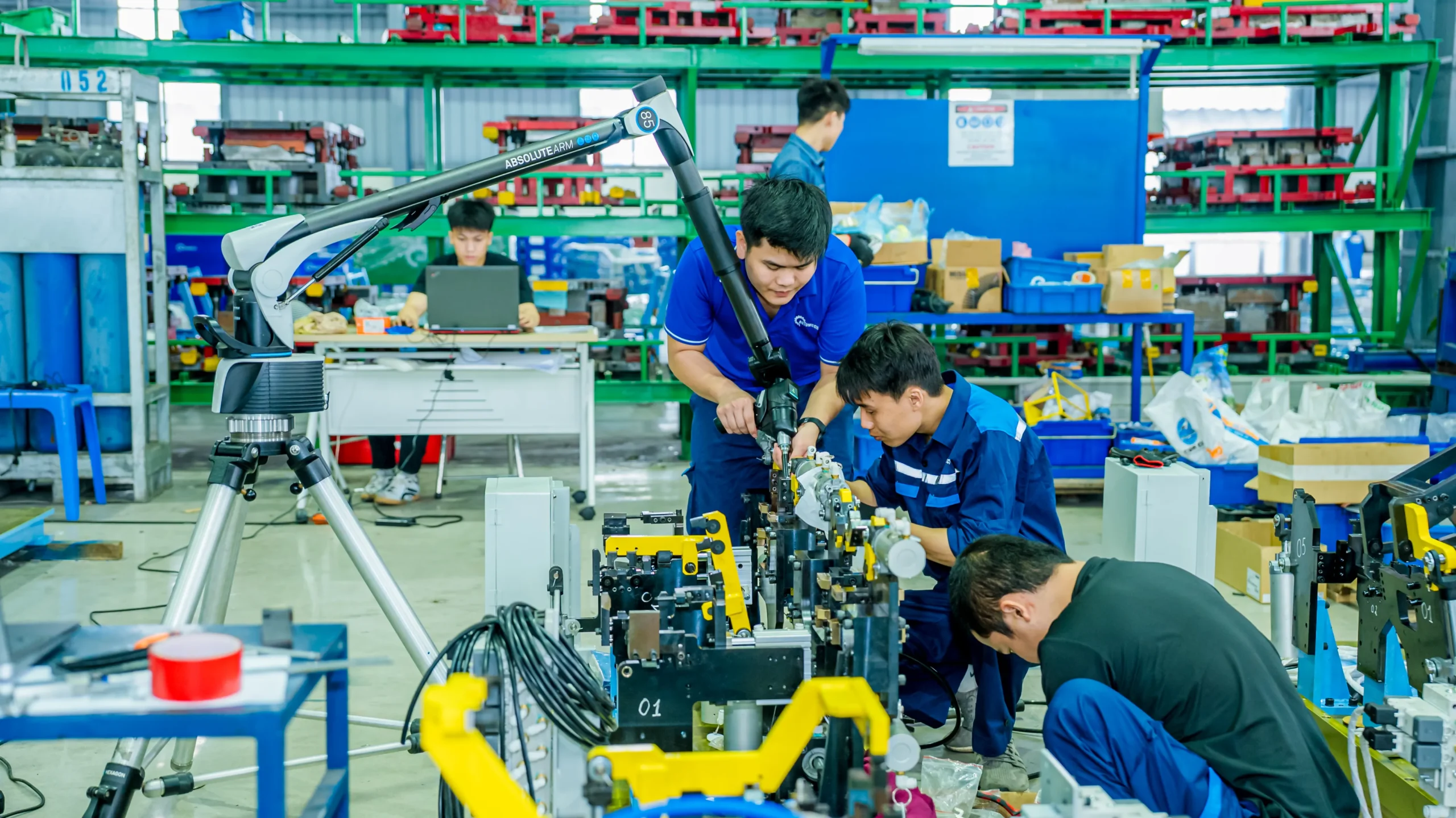
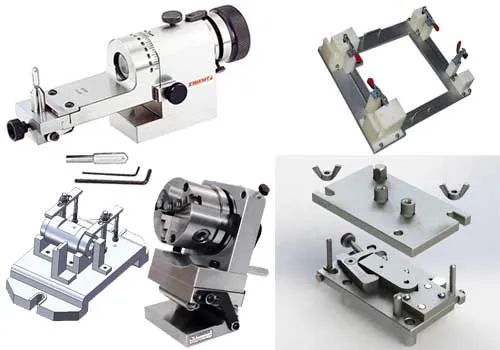
Choosing specialized fixture designs for complex products
6.1. Selection Guidelines
-
Workpiece type (shape, material, accuracy).
-
Machine to be used.
-
Production volume (mass, batch, or single piece).
6.2. Custom Fixture Design
When standard fixtures cannot meet accuracy or productivity requirements, custom fixtures are necessary. Work with trusted design specialists for thorough analysis.
6.3. Buy Standard or Custom?
-
Standard fixtures: Best for simple, low-volume jobs. Cost-effective and readily available.
-
Custom fixtures: Required for complex, high-accuracy, large-volume production. Higher cost, but maximum efficiency.
7. Fixture Pricing & Suppliers
7.1. Price Factors
-
Design complexity.
-
Material (C45 steel, SKD11, aluminum, etc.).
-
Accuracy requirements.
-
Clamping mechanism (mechanical, hydraulic, pneumatic).
-
Order quantity.
7.2. Reference Price Range
-
Simple fixtures: a few million VND.
-
Complex automated fixture systems: hundreds of millions VND.
7.3. Trusted Suppliers in Vietnam – Selection Criteria
Instead of specific names, focus on:
-
Engineering capabilities: Review past projects and team expertise.
-
Facilities & machinery: In-house manufacturing and quality control.
-
Customer service: Warranty, maintenance, and technical support.
8. Proper Maintenance & Usage

Regular maintenance helps extend the service life of fixtures
8.1. Maintenance Guidelines
-
Clean after every use, remove chips & oil.
-
Apply anti-rust oil on working surfaces.
-
Inspect locating pins and clamps for wear.
-
Store in dry, impact-free conditions.
8.2. Common Issues & Solutions
-
Locating error: Worn locating pins → replace.
-
Weak clamping force: Loose/damaged mechanism → tighten or repair.
-
Workpiece deformation: Excessive clamping force or wrong clamping point → adjust.
8.3. Fixture Changeover Precautions
-
Ensure clean contact surfaces between fixture and machine table.
-
Evenly tighten fixture bolts.
-
Re-check machine reference points (G54, G55…) after fixture change.
✅ Investing in the right fixtures and using them effectively will significantly enhance your production capability.
AUTOMECH MANUFACTURING AUTOMATION DIES AND TOOLS JSC
Address: Lot E5, Dinh Tram Industrial Zone, Nenh Ward, Bac Ninh, Vietnam
Hotline: +84 907 89 89 62
Website: automechtool.vn
Fanpage: Automech Manufacturing Automation Dies and Tools JSC
YouTube: AutomechKhuonTools